
Can I Learn Interior Design Without a Design Background?
Introduction
How do you become an interior designer without formal training? One of the biggest myths in the interior design world is that you need a degree to break into this field. The global interior design services market is growing by $23.15 billion through 2023 and creates opportunities for career changers and self-taught professionals. You might be curious about what interior designers do or think about an interior design career. You might be learning what interior design course options exist or asking yourself is interior designing a good career. This piece will show you practical paths forward without an interior decoration degree.
What Is Interior Design and What Does an Interior Designer Do
Interior design is the art and science of understanding people’s behavior to create functional spaces within a building. At its core, what is interior design involves more than selecting colors and furniture. The profession centers on how spaces affect the people who inhabit them and influences how they think, feel, and act.
Core Responsibilities of Interior Designers
Interior designers physically design spaces rather than simply improve their appearance. Your work as an interior designer would involve determining how spaces function, ensuring safety standards, and creating beauty through choices you consider about materials, lighting, and layout.
The daily responsibilities include:
- You meet with clients to determine goals, budget, and requirements for projects
- You sketch preliminary design plans, including electrical and partition layouts
- You specify materials and furnishings such as lighting, furniture, wall finishes, and flooring
- You create project timelines and estimate costs
- You place orders for materials and oversee installation of design elements
- You coordinate with architects, engineers, and contractors to implement plans
- You visit sites after project completion to ensure client satisfaction
What interior designer do extends beyond esthetics. You would conduct on-site observations, prepare client presentations, and manage projects from concept to completion. The work requires reading blueprints and understanding building codes, inspection regulations, and accessibility standards. Designers use computer-aided design (CAD) software for most drawings and building information modeling (BIM) software to create three-dimensional visualizations.
One professional notes that 10 percent is design and 90 percent is execution of that design. This reality distinguishes interior design as a profession that demands both creative vision and technical expertise.
Interior Design vs Interior Decoration
The difference between interior designers and decorators affects what you can do and how you position yourself professionally. Interior design is the art and science of understanding behavior to create functional spaces, while interior decorating focuses on furnishing or adorning a space with decorative elements to achieve a certain esthetic.
Decorators adorn the box, while interior designers create the box. Interior designers may decorate, but decorators do not design. Designers apply creative and technical solutions within a structure that are functional, attractive, and beneficial to occupants’ quality of life. They respond to and coordinate with the building shell and acknowledge the physical location and social context of projects.
The educational requirements differ a lot. Interior design requires specific education including color and fabric study, CAD training, drawing, space planning, furniture design, and architecture. Designers often apprentice with registered professionals before launching their own companies. Some states and provinces require professional designers to pass exams and become registered with governing councils. Only licensed designers may use the title “interior designer” in certain jurisdictions.
Decorators require no formal training or licensure. Be that as it may, experienced decorators can work well with contractors through long practice.
Is Interior Design a Good Career Choice
The interior design services market growth indicates strong career potential. India’s interior design market is expected to grow, driven by urbanization, premium housing, co-working spaces, and lifestyle upgrades. The interior design industry is valued at over USD 150 billion around the world.
Salary ranges in India demonstrate income progression. Entry-level designers earn ₹3-5 LPA (lakhs per annum), while mid-level professionals earn ₹6-10 LPA. Experienced designers and freelancers can earn much more through project-based work. Freelancing, studio ownership, and niche expertise often lead to exponential income growth rather than linear salary progression.
This career suits those who want creative freedom, diverse projects, and long-term growth rather than routine desk jobs. Interior design offers both employment and entrepreneurship paths, including roles as residential or commercial designers, furniture or spatial designers, retail design specialists, set and exhibition designers, or independent consultants.
The profession sits at the intersection of human behavior, architecture, and functionality. You would shape how people move, feel, and function inside spaces in homes, offices, retail environments, hospitality spaces, and exhibitions. Each environment demands a different design mindset and provides variety throughout your career.
Essential Skills You Need (Even Without Formal Training)
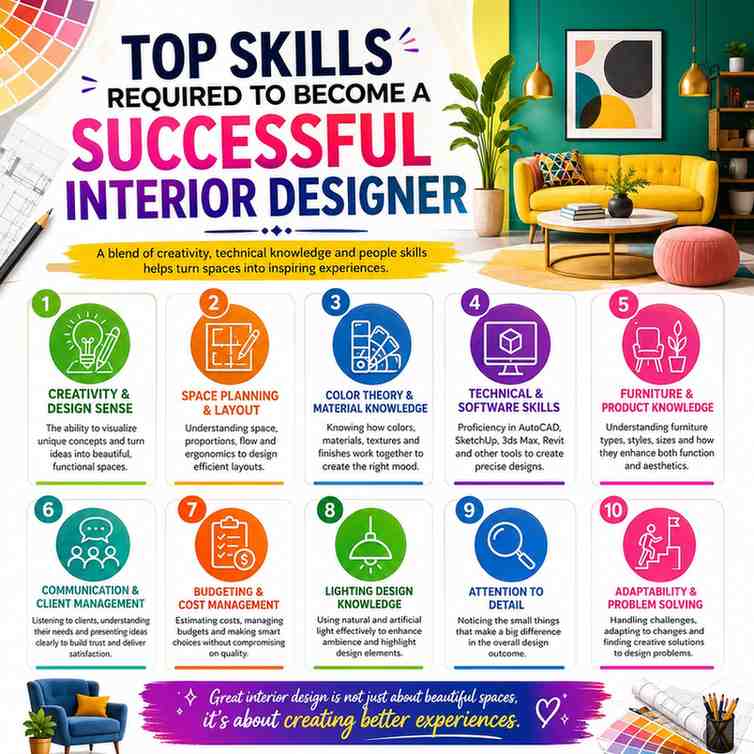
Breaking into interior design without formal education requires developing three distinct skill categories. 84% of architects and designers predict growing need for healthy, sustainable spaces. The industry just needs professionals who can deliver results, whatever their educational background.
Creative Skills You Can Develop
Your creative abilities determine how you visualize changes to improve spaces and make people relax or feel comfortable in those areas. Color theory is the foundation of design decisions and affects mood, accessibility, and functionality of any area. You just need to understand how different colors interact, which combinations create specific emotional responses, and how lighting conditions alter color perception throughout the day.
Spatial awareness allows you to imagine three-dimensional spaces before anything gets built. You visualize how different design elements interact and create cohesive environments that reflect client priorities while maintaining functional efficiency. This skill involves translating ideas into layouts and sketches and combining colors, textures, and forms thoughtfully rather than repeating trends.
Open-minded thinking and brainstorming capabilities help you approach each project without predetermined solutions. Creative problem-solving becomes necessary when budgets get cut by 30% or when contractors find support beams where you planned kitchen islands. You discover solutions that keep projects moving forward without compromising what matters most to clients.
Technical Skills That Can Be Learned
Technology streamlines processes and improves quality of design operations. Software proficiency is non-negotiable for modern practice. AutoCAD handles foundational 2D work and creates floor plans, elevations, and detailed drawings with precise measurements that contractors can use. SketchUp shines when showing clients what their spaces will look like and turns flat plans into walkable three-dimensional models that clients understand instantly while technical drawings often leave them confused.
Revit becomes important for larger projects that require coordination with architects and engineers. This Building Information Modeling software lets everyone work from the same digital model and reduces errors and miscommunication.
Space planning skills can result in up to a 30% improvement in space utilization. You create efficient layouts for different room sizes, manage circulation and furniture placement, and balance esthetics with usability. Good circulation paths feel natural rather than forced. People shouldn’t weave around furniture or bump into corners.
Materials knowledge extends beyond esthetics. Each fabric, finish, and surface just needs to perform specific jobs while matching your design vision. You must understand properties, durability, and environmental effect of various materials and recommend the right tile for high-traffic mudrooms versus guest powder rooms. Building codes protect people’s safety and health. They affect every design decision you make as legal requirements rather than suggestions.
Transferable Skills from Other Careers
Your current job provides skills that translate directly into interior design practice. Project management experience helps you handle multiple responsibilities at once and juggle creative work, coordination, and execution while staying on schedule and within budget. Time management becomes essential since interior design rarely follows a 9-to-5 schedule.
Problem-solving abilities from any field apply when unexpected issues arise during building or renovations. Critical thinking skills help you develop proactive solutions. One-third of design projects miss deadlines or blow budgets because of poor collaboration. Organizational skills from previous careers become valuable assets.
Adaptability matters when delays in supply chains, client whims, or sudden rescheduling throw plans off course. Knowing how to deal with these changes in a practical, calm, and organized manner demonstrates professional maturity.
People and Communication Skills
Every conversation with a client requires translating design concepts into plain English. Clients say they want something “cozier.” You just need to understand whether they mean warmer colors, softer textures, or more intimate furniture arrangements, then explain your solutions in ways that make sense to them rather than to other designers.
Active listening and verbal communication skills help clarify client desires and allow you to better understand their expectations for spaces you’re designing. Clients who feel heard throughout the process are 50% more likely to return for future projects. Presentation and negotiation abilities prove valuable when working with vendors, contractors, and suppliers to achieve project goals within budget constraints.
Written communication maintains clear documentation throughout projects. Your communication forms the first impression clients get before they see your portfolio or previous design work.
Education Paths for Non-Design Backgrounds
Do You Really Need an Interior Decoration Degree
The question of whether you need a degree to work as an interior designer has a straightforward answer: no, it’s not a legal requirement in most locations. This fact changes everything for career changers and self-taught professionals.
Many successful designers have launched careers through alternative pathways that prioritize hands-on experience and creativity. Kelly Hoppen and Shea McGee are self-taught interior designers without formal design degrees. Vanessa Arbuthnott, Jonathan Adler, and Nina Campbell built their careers the same way.
Asking whether you need a design degree to become an interior designer is like asking whether you need a writing degree to become a writer. Formal education offers value, but it’s also expensive and time-consuming. Countless designers have successful, rewarding careers without one. Architects are legally required to earn degrees before working on legitimate projects, in contrast.
The answer depends on what you want to do with your career. You do not need an interior design degree to complete projects for clients or run your own business. Formal credentials remain optional, especially for entry-level or residential design roles. But if you want to work on commercial projects or as part of an architectural design team, having a degree may provide the credentials you need.
Self-Study and Online Interior Design Courses
You can develop a strong understanding of design principles, spatial planning, balance, color theory, and texture coordination through self-study, online courses, books, and YouTube tutorials. Key areas cover visual storytelling, furniture styles and materials, and lighting techniques. Creativity can be innate, but you can also develop it through practice and exposure to the design world.
The Interior Design Institute offers two online courses tailored to career or hobby ambitions. Students enrolled in the Certificate course receive 12 months to complete the program. Students enrolled in the Diploma course receive 18 months to complete their studies. You can purchase extensions for added flexibility. The self-paced nature allows you to balance studies with work or personal commitments.
Professional Diploma and Certificate Programs
Certificate programs are known for their shorter duration, ranging from a few months to a year. They focus on imparting design skills and knowledge, covering core design principles, color theory, space planning, and interior materials. These programs can cost less than degree programs, though students may have fewer options for scholarships or financial aid.
Professional diploma programs offer middle-ground options between self-study and full degrees. The 12-month hybrid program at BSD blends live online learning with real-life exposure through campus locations. Students complete the 16-month academic program consisting of three semesters, then enter the 3+1 Internship Advantage, which has three months of industry internship and one month of guided portfolio development.
One-year diploma programs focus on creative planning and skilled design of interior spaces. These shorter-duration courses help you acquire technical skills and expertise to familiarize yourself with design trends and software knowledge. Entry requirements include completion of 10+2 from any recognized board.
Bachelor’s Degree vs Alternative Routes
Foundation degrees, higher national diplomas, or degrees in subjects like interior design, art and design, or interior architecture represent traditional paths. Entry requirements usually mean one or two A levels for foundation degrees or higher national diplomas, and two to three A levels for full degrees.
Bachelor’s degree programs demand extended commitments, often spanning four years, while associate degree programs take about two years. These programs offer broader curriculum covering design history, environmental sustainability, technical drawing, and computer-aided design. Degree programs include internships or cooperative work experiences that enable students to gain practical experience.
Alternative routes provide faster entry. You could start as an interior design assistant with a company, then become an interior designer with further training and qualifications. Furniture Design Technician Level 3 Advanced Apprenticeships may lead into interior design assistant roles. College courses in interior design or art and design may help with applications for design assistant jobs or university courses.
Practical Ways to Learn Interior Design on Your Own
Start with Your Own Space Projects
Design your own space where you spend the most amount of time. Before you begin, take pictures that capture every angle and current state. Make a floorplan that shows accurate measurements and existing features. Study your lighting sources and note how natural light moves through the space at different times and where artificial lighting creates shadows or emphasizes certain areas.
Redecorate your own home as a design challenge and go through the full process as you would for a client. Ask friends if you can help redesign their homes for free. Spread the word in the community that you’re offering free design services through social media platforms like Instagram.
Free and Paid Learning Resources
Oxford Home Study Center offers 20 hours of content covering color, lighting and decoration fundamentals. The curriculum covers space planning, color theory, room composition, furniture selection and lighting techniques. eLearning College provides endorsed interior design courses online for free with no time limitations or deadlines.
Libraries offer interior design books, magazines and other resources available with just a library card. YouTube serves as a valuable learning resource for design principles, software tutorials, industry trends and developing your design eye. HGTV’s blog functions as a detailed guide with each page teaching a particular topic and contains additional videos, articles and slideshows at the bottom.
Learning Design Software Without a Degree
AutoCAD and SketchUp Pro represent industry-standard programs worth learning. Free web applications like HomeByMe and SketchUp Free allow you to create professional-quality designs and floor plans. Photoshop Launch offers 73 minutes of focused training on creating eye-catching drafts quickly and eliminates surplus explanations and functions you might never use.
YouTube provides step-by-step sketching tutorials for one or two-point perspectives. Lynda offers tutorials that guide you through SketchUp and Revit and show how to include products with plans and create work plans to streamline construction phases.
Understanding Interior Design Subjects Through Practice
Study color psychology and its application in interior design. Use neutral tones and color schemes. Learn why surfaces and textures are important components. Explore common surface materials and how to realize their full potential. Understand the three main types of lighting used in residential and commercial spaces.
Develop knowledge of furniture history, popular interior design styles in use and how to select the right piece for a space. Work with textiles and accessories. Study common natural and synthetic fibers with their advantages and disadvantages.
Learning Space Planning and Layout Basics
Space planning addresses how people will move through and use buildings. Define room types according to conceptual use: social spaces for gathering, private areas like bedrooms and work zones including home offices. Define activity zones within rooms based on their main purpose.
Create clear pathways between spaces that interact frequently to think about traffic flow. Factor in spatial dimensions and pay particular attention to hard-working rooms like kitchens where appliances and people need breathing space. Account for room proportion and ensure furniture scale matches the space without dominating it.
Building Your Portfolio from Scratch
Creating Projects Without Clients
Small residential projects work best for those who have never worked under a designer or completed professional projects. Color consultations, e-design concepts, or single room projects requiring only decoration minimize risk while you build experience. Projects for friends or family make sense since these clients already know you and will be more forgiving if mistakes occur. Swap services with other business owners you meet through networking to complete small projects fast. Design competitions that match the types of projects you want to work on keep your ideas fresh while building portfolio content. Small staged vignettes or flat-lays work better than waiting for completed, photographed spaces. Craft or DIY projects matter no matter how small they seem. Many designers received their first client requests after showcasing domestic projects on social media.
Using Mock Projects and Redesigns
Speculative work has the same value as client work in demonstrating your potential. Work on your dream interior design project to hone and refine your work process before taking on actual clients. Treat hypothetical projects like real jobs. Write briefs, explain your design approach, and show final results through sketches, digital floor plans, and 3D renderings. A full house project from scratch including space planning and 3D visualization showcases your skills at the time you lack client work due to copyright restrictions from previous employment. Develop the layout in SketchUp, add finishes and lighting to reflect your design esthetic, render it in Enscape for realistic visuals. Assemble your presentation with floor plans, materials, and final renderings. This approach shows confidence and initiative, the same traits clients seek at the time of hiring designers.
Documenting Your Learning Experience
Your design process matters more than the finished product. Photograph or document it. Development sketches, research, mood boards, and model making allow potential employers to understand your creative experience and problem-solving skills. Different versions you thought about highlight how you work through challenges. Before-and-after shots serve as powerful demonstrations of your effect. Case studies with real challenges and your solutions show versatility. The story of each project from start to finish should include concept sketches, mood boards, material palettes, color choices, floor plans, and renderings. Short notes explaining the reasoning behind your decisions and the challenges you worked through add depth.
What to Include in a Beginner Portfolio
Select work demonstrating both a range of skill sets and versatility. Quality over quantity is the rule. Employers want technical abilities, including technical floor plans, elevations, sections, 3D visualizations, isometric drawings, and detail drawings. These showcase your proficiency with design software and ability to translate ideas into reality. Projects showing different aspects of your skills like material selection, lighting, color schemes, or solving difficult challenges such as limited space or awkward layouts belong in your portfolio. Structure your portfolio with clear headings for each project, table of contents, and page numbering for quick reference. A brief statement about your design approach adds personality. Adopt a consistent, visually appealing layout reflecting your esthetic. Personal information like a bio or resume shares your professional background.
Breaking Into the Interior Design Career
Getting Your First Interior Design Experience
Find a position with a firm and learn everything you can. Give it your all like you were in school. This really is the best way to start. Experience in related fields opens doors: construction, retail furnishings, window treatment shops, or real estate provide solid experience to get jobs that further your knowledge. Shadow a contractor, plumber, or electrician for half a day weekly to learn technical aspects of the industry through doing. This separates you from other designers and makes you more marketable to clients.
Internships and Entry-Level Opportunities
Interior design interns work together with designers, contractors, and vendors. They gain project experience from inception through installation. Responsibilities include creating outlines and models with Photoshop and InDesign, preparing CAD drawings, and liaising between designers, architects, and clients. They also assist with budgeting. Past interns have been involved in product research, sample and library management, and sourcing images for mood boards. They record measurements, photograph spaces, and contact suppliers.
Networking Without Design School Connections
Go to markets, KBIS, and any conferences you can afford. Network and surround yourself with creatives. These places afford opportunities to network, meet vendors, ask questions, and learn real-life skills. Join professional organizations such as the American Society of Interior Designers (ASID) or the International Interior Design Association (IIDA) to connect with peers and attend industry events. You can stay updated on trends.
Positioning Yourself as a Self-Taught Designer
Avoid sending shots of your home with words on the wall when applying to potential employers. Don’t claim you’re good at design because you decorated your cousin’s wedding with mason jars and that all your friends tell you so. Build an online presence through a professional website and social media profiles. Share your work and design tips. Engage with potential clients to build your reputation.
Is Interior Decorator a Good Career Starting Point
Interior designers physically design spaces in houses or buildings. Decorators only increase the esthetic appeal by altering esthetics. You will most likely be limited to providing more styling and decorating-types of services in the beginning. These are still beneficial and specific niches of interior design that you might choose to specialize in. Deciding between pursuing interior design as career or starting as a decorator depends on personal interests and educational requirements you’re willing to pursue. Career trajectory goals matter too.
Conclusion
Breaking into interior design without a formal degree is possible if you commit to developing the right skills. Your success depends on building practical experience through personal projects and creating a strong portfolio that showcases your abilities rather than your credentials.
The path forward requires action. Start redesigning your own spaces, take online courses, and network within the industry. Keep in mind, clients care about results and knowing how to solve their design challenges, not where you earned your education.
You can begin as a decorator or jump straight into design work. Your dedication and portfolio will open doors faster than any degree ever could.
FAQs
Q1. Is it possible to become an interior designer without a formal degree?
Yes, you can learn interior design without a formal degree. Many successful designers are self-taught and have built careers through online courses, self-study, practical experience, and building strong portfolios. While formal education offers advantages, it’s not legally required in most locations to work as an interior designer or decorator.
Q2. What’s the difference between interior design and interior decorating?
Interior design involves the technical planning and creation of functional spaces, including knowledge of building codes, safety standards, and space planning. Interior decorating focuses primarily on the esthetic aspects selecting furniture, colors, and decorative elements to enhance existing spaces. Designers create the structure, while decorators enhance its appearance.
Q3. What skills do I need to develop to start a career in interior design?
You’ll need to develop creative skills like color theory and spatial awareness, technical skills including design software (AutoCAD, SketchUp), space planning abilities, and materials knowledge. Strong communication skills, project management capabilities, and problem-solving abilities are equally important for working with clients and managing projects successfully.
Q4. How can I build a portfolio without having any clients?
Start by redesigning your own spaces and documenting the process with before-and-after photos. Create mock projects and speculative designs, offer free services to friends and family, develop concept boards and 3D renderings for hypothetical spaces, and participate in design competitions. Quality matters more than quantity in showcasing your skills.
Q5. What learning resources are available for self-taught interior designers?
You can access free resources like YouTube tutorials, library books, and design magazines, as well as paid options including online courses from institutions like the Interior Design Institute. Practice with free design software like SketchUp Free and HomeByMe, study design principles through blogs and HGTV content, and consider certificate programs from community colleges for structured learning.