
AI vs Human Creativity in Fashion Designing
Artificial intelligence in fashion design has captured the attention of industry leaders. About 73% of fashion executives consider generative AI a top priority to their businesses. AI can create hundreds of design concepts in minutes and analyze years of trend data in an instant. Yet fashion has always been about emotional connection, cultural storytelling, and human intuition. The question is not whether AI will replace human designers, but how these two forces work together. This piece explores what AI brings to the table and what humans offer, examining the role of artificial intelligence in fashion design moving forward.
What is AI in Fashion Design
Artificial intelligence in fashion design refers to machine learning systems and generative models that handle tasks ranging from original concept exploration to final production readiness. These tools process design briefs, generate variations, create technical specifications, and produce market-ready visuals without traditional manual workflows.
AI in Design Process: From Concept to Production
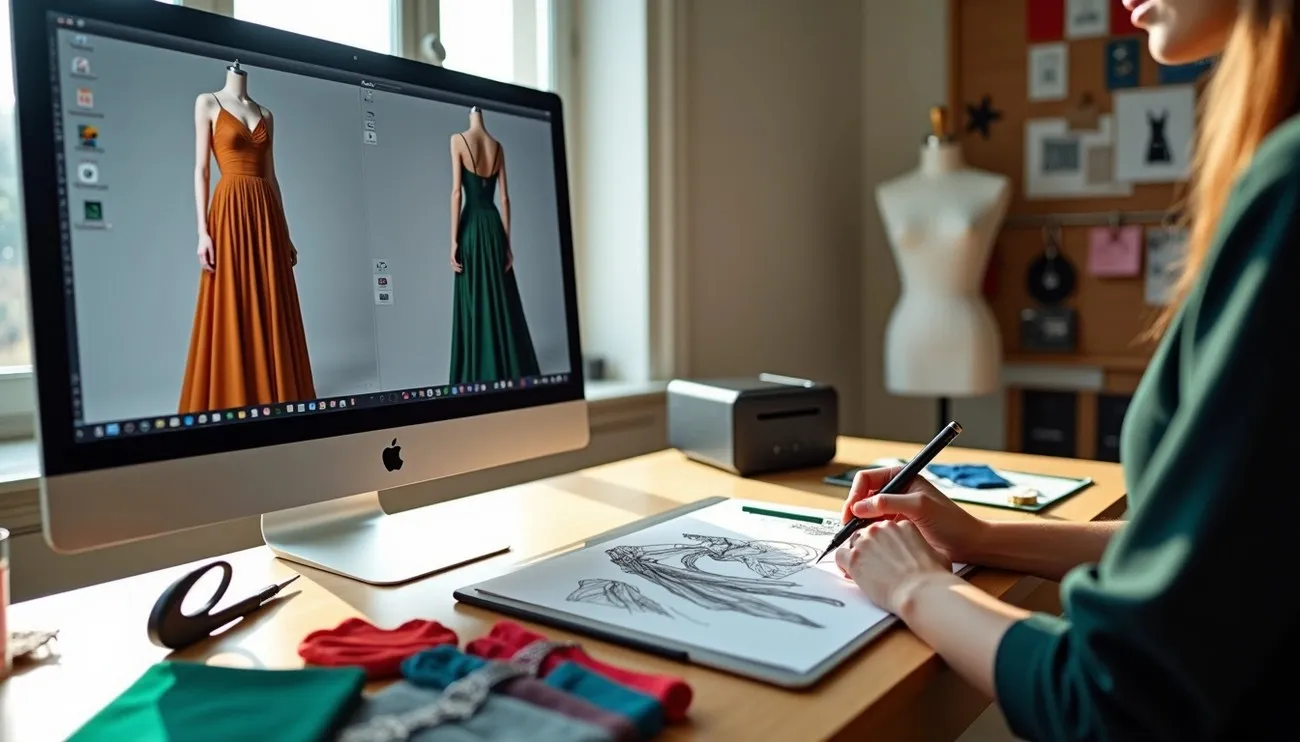
Fashion design workflows have compressed from months to days. Designers generate seasonal collections, prepare line sheets, and visualize concepts in days instead of weeks or months. Teams can explore 20 different variations of a jacket silhouette within minutes with AI tools, filtering weak ideas early and focusing on promising designs. Stakeholders approve original concepts through cloud platforms. Selected styles then move into development phases where teams refine them and prepare them for production with precision. Tech pack converters create photorealistic garment images from technical drawings and eliminate physical samples. Around 15% of textiles intended for clothing production are wasted during the cutting process when creating fashion samples, which makes this matter.
Photorealistic Design Generation
AI-powered mockup tools like Mock It AI and Dynamic Mockups create realistic visuals without pricey photoshoots. Users customize models, outfits, and backdrops to produce professional-grade images in minutes. Genera’s Product Display Page Creator tool creates a single product page with proper garment fit, set design, and retouched imagery. It produces four ready-to-use pictures in less than 30 minutes, while traditional photoshoots take about half a day. The technology has reached commercial readiness. Midjourney V.6 makes the difference between AI-generated and traditional photography subtle. Fashion brands transform images of clothes on plastic mannequins into visuals featuring AI-generated human models across different body shapes, sizes, races, and age groups.
Virtual Try-On and Visualization
Virtual try-on technology allows customers to visualize clothing on their bodies without physical trials. The AR market is set to reach INR 16707.33bn by 2025, up from just INR 295.33bn in 2017. Fashion brands using virtual try-on report conversion rate increases up to 400%. Some retailers average 64% fewer returns compared to those not offering the service. Google’s virtual try-on enables shoppers to try billions of apparel listings using uploaded photos, powered by custom image generation models that understand how materials fold, stretch, and drape on different bodies.
Supply Chain and Trend Prediction AI
Machine learning models analyze demand patterns to prevent overproduction. Brands like Octavia have reduced unnecessary inventory by over 40% and kept garments out of landfills. AI trend forecasting systems monitor millions of social media posts, street style photographs, runway images, and search queries live to identify emerging esthetic signals before they become mainstream. Fast-fashion brands identifying a trend six weeks earlier than competitors can capture the market at full price instead of arriving late to saturated inventory. AI automation handles repetitive tasks such as data entry, workflow tracking, and inventory updates. This allows teams to focus on strategic decisions.
Human Fashion Design: Creativity That Machines Cannot Replicate
Designers possess what many describe as a sixth sense, a gut feeling that guides decisions without conscious analysis. This intuition allows recognition of potential in unexpected fabric combinations or identification of color trends before they appear at major fashion events. Coco Chanel’s little black dress exemplifies this phenomenon. The design emerged from understanding how women’s needs changed during the 1920s, not from careful planning or data analysis. Contemporary designers mix old-fashioned handwoven fabrics with innovative 3D printing methods and create designs that feel both nostalgic and forward-looking. Algorithms cannot replicate such intuitive leaps, as they require sensing future trends by referencing historical ideas in ways data patterns cannot predict.
Intuition and Artistic Vision
Traditional fashion design stays tactile. Designers feel silk between their fingers, work with graphite smudges on sketches, and make subtle seam adjustments during fittings. Every decision reflects personal taste, experience, and artistic control. Happy accidents during the creative process often define entire collections and produce distinctive results that resist replication.
Emotional Intelligence in Design
Fashion carries more than stitches and seams. Designers create memory holders worn during important moments—first interviews, weddings, celebrations, and difficult days. This emotional layer requires understanding how garments make wearers feel. Will this dress build confidence when walking into a room? Will this fabric provide comfort on a long day? Emotional intelligence enables designers to lead with empathy, handle sensitive feedback, and manage multicultural teams. Clothing affects how people feel about themselves and makes empathetic design necessary rather than optional.
Cultural Sensitivity and Storytelling
Cultural elements demand deep research and genuine collaboration with artisan communities. Designers must understand the history, significance, and current meaning of traditional practices before incorporating them. This involves engaging cultural experts, ensuring fair compensation for craftspeople, and respecting sacred symbols. Elements worn during religious or mourning ceremonies should not be used for casual wear. Successful cultural storytelling requires brands to celebrate culture rather than exploit it, with proper credit and acknowledgment of sources.
Breaking Rules and State-of-the-art
Designer Demna Gvasalia used irony and absurdity to flip fashion expectations. Balenciaga buyers purchased not just for style but for anti-fashion statements. Diesel’s ugly-cool approach works through authenticity and speaks to generations that reject polished perfection. This demonstrates how understanding consumer psychology, emotional branding, and timing creates market-defining movements. The lesson remains clear: boldness outperforms safe beauty. Fashion innovation happens when designers challenge conventional norms rather than following predictable patterns.
Direct Comparison: AI vs Human Fashion Design Capabilities
Research comparing human and AI-generated fashion designs reveals distinct performance patterns across capability areas.
Creative Originality and State-of-the-Art
Studies show human-created designs demonstrate greater diversity and uniqueness compared to AI outputs. Human designers find unique ways to construct and apply ideas to their work intuitively. Consumer perception research indicates that AI-designed products receive stronger negative attitudes for low-state-of-the-art items. High-state-of-the-art designs face less resistance. Participants notice AI-designed products as less original when state-of-the-art levels remain low. This suggests artificial intelligence in fashion design works better for avant-garde approaches than conventional pieces.
Technical Execution Speed
Time advantages favor AI. First concept generation takes seconds with AI versus days to weeks through traditional methods. Pattern development drops from 8-12 hours to 10 minutes using AI-powered solutions. Complete cycles span 6-12 months but compress to 2-8 weeks with AI tools traditionally. Implementation delivers 70-99% time savings across pattern development, design iteration and sampling phases.
Trend Analysis and Market Understanding
AI excels at data processing. Machine learning algorithms analyze social trends, shopping behavior, sales histories and weather patterns to predict future styles. Immediate consumer trend tracking gives brands speed advantages that traditional intuition-based forecasting cannot provide. But strategic direction just needs cultural context that AI lacks. Knowing which esthetic fits a specific brand, audience and moment requires human judgment. AI produces work that is technically competent without the taste and editorial curation professionals provide.
Brand Identity Development
Brand development separates the approaches. AI tools pull from existing styles and templates, mimicking rather than originating. Systems cannot understand deeper purpose, mission, vision and values that define companies. Professional designers ensure elements line up with long-term business goals. AI follows patterns but cannot copy the intuition and creativity human designers bring to psychological branding.
Adaptability to Unexpected Challenges
Brief interpretation represents a human skill. Understanding what projects actually need versus what was said develops through experience. AI produces outputs but does not interpret briefs. Cultural and contextual sensitivity to determine when design directions suit their moment remains human territory.
Cost and Resource Requirements
Economic differences prove dramatic. AI starts free with 10 credits monthly versus studio fees and hired designers. Brands switching to AI-assisted workflows achieve positive ROI within 3-6 months. Cost reductions reach 90-99% for specific applications. Iteration economics change, making fifty design variations practical where it was not previously.
How Complex Systems Get Engaged in Fashion Design Creation Using AI
Implementation of artificial intelligence in fashion design creation reveals a critical pattern: AI benefits experienced designers substantially more than beginners. Research with 640 entrepreneurs found that AI assistance boosted profits by 10-15% for high-performing individuals, while lowering results for struggling performers by approximately 8%. This disparity demonstrates that human judgment remains essential to interpret and apply AI outputs.
AI-Human Collaboration in Real Design Studios
ASOS trained over 100 designers in generative AI capabilities and embedded the technology across design operations. Designers transform sketches into photorealistic visuals instantly and learn different colors, fabrics, and variations while improving communication clarity with suppliers. Research studying 76 Master’s students using AI tools identified four distinct collaboration patterns. Smooth Partnership represents optimal outcomes where both human expertise and AI capabilities contribute throughout the design process. AI Catalyst uses artificial intelligence to expand creative boundaries while designers maintain strategic oversight. Human Control keeps designers in command and uses AI for analysis and refinement. Conversely, Passive Acceptance creates a danger zone where designers overestimate AI capabilities without providing proper direction, resulting in fragmented outputs that lack brand consistency.
When to Use AI Tools vs Human Judgment
AI works better as a sounding board than as a ghostwriter. Studies found that using AI to generate complete content delivered no benefit to expert users and reduced their performance, whereas treating it as a collaborative tool proved beneficial. High-stakes outputs demanding cultural sensitivity, emotional intelligence, or interpersonal understanding need human leadership. AI excels at pattern recognition and data processing but cannot access tacit knowledge about brand positioning, customer psychology, or strategic direction that professionals develop through experience.
Training AI on Brand-Specific Design DNA
Pattern intelligence platforms learn from existing DXF pattern libraries to understand brand-specific fit approaches, ease distribution, dart placement, seam allowances, and grading rules. The training process requires 2-3 weeks depending on pattern library size. Systems analyze thousands of data points from historical patterns to maintain learned characteristics when generating new designs. Brand DNA training extends beyond patterns to include approved tech packs, material choices, construction priorities, factory feedback, and recurring fit issues. This creates rule layers that keep AI outputs consistent with creative direction and customer promises.
The Future: AI and Human Designers Working Together
Fashion work structure is being redrawn. The industry enters an era defined by technology and accountability, no longer governed by intuition or esthetics alone. Creative skills undergo fundamental changes.
Emerging Hybrid Roles in Fashion
The industry will seek hybrid professionals skilled in both craftsmanship and technology by 2026. These individuals create new positions rather than filling traditional roles. They combine artistry and analytics. Industrial Pattern Makers 4.0 translate tradition into precision engineering. AI Prompt Engineers teach teams how to use AI tools and build workflows professionally. AI Designers, typically from fashion backgrounds, create product images and edit campaign concepts. They support development teams with visual material. AI Personalization and Client Insights Scientists organize customer data and improve recommendations. They identify buying patterns. Computer-aided design adoption in the 1980s grew global fashion designers from 40,000 to roughly 120,000. Small businesses and design students can afford AI systems. Monthly subscriptions start at £50.
Skills Designers Need for AI Era
Success depends on AI literacy by 2030: knowing how to direct and manage artificial intelligence. The World Economic Forum states that sought-after careers will merge technological expertise with creative thinking. Critical thinking and prompt writing remain key human skills. Information verification does too. Curiosity and mental agility prove more valuable than mastering specific tools. Continuous learning matters. Only 32% of fashion students view AI’s career effect positively. Design companies using AI see 38% greater growth effect despite this evidence.
Why Full Automation Will Not Replace Designers
AI cannot copy cultural intuition or understand the emotional weight of garments in specific cultural contexts. Human designers possess tactile experience with fabric behavior on bodies. They have instinct for what feels right versus what merely looks correct. Designers who understand AI as a tool will remain competitive in markets. Most work results from human-AI cooperation in these markets.
Comparison Table
Comparison Table: AI vs Human Creativity in Fashion Designing
Aspect | AI Fashion Design | Human Fashion Design |
Creative Originality | Lower diversity and uniqueness; better for avant-garde approaches than conventional pieces; mimics existing styles rather than originating | Greater diversity and uniqueness; finds unique ways of constructing and applying ideas intuitively |
Design Speed | First concept generation: seconds; Pattern development: 10 minutes; Complete cycle: 2-8 weeks | First concept generation: days to weeks; Pattern development: 8-12 hours; Complete cycle: 6-12 months |
Time Savings | 70-99% time savings in pattern development, design iteration and sampling phases | N/A (baseline) |
Trend Analysis | Analyzes millions of social media posts, street style photos and runway images live; processes social trends, shopping behavior, sales histories and weather patterns | Relies on intuition and experience; sixth sense identifies trends before they appear at major fashion events |
Market Understanding | Excels at data processing; provides speed advantages in consumer trend tracking | Provides cultural context, strategic direction, taste and editorial curation that AI lacks |
Brand Identity Development | Pulls from existing styles and templates; cannot understand deeper purpose, mission, vision and values | Makes sure elements line up with long-term business goals; brings intuition and creativity to psychological branding |
Emotional Intelligence | Cannot understand emotional weight of garments or how they make wearers feel | Creates designs that consider how garments affect confidence, comfort and emotional connection |
Cultural Sensitivity | Lacks cultural and contextual sensitivity | Conducts full research, cooperates with artisan communities and respects sacred symbols and traditions |
Adaptability | Produces outputs but does not interpret briefs; cannot understand what projects need versus what was said | Interprets briefs through experience; determines when design directions suit their moment |
Innovation Approach | Follows patterns and data; competent but lacks taste | Breaks rules, uses irony and absurdity, creates anti-fashion statements and market-defining movements |
Cost | Free options with 10 credits monthly; monthly subscriptions starting at £50; 90-99% cost reduction for specific applications | Studio fees and hired designers required; traditional cost structure |
ROI Timeline | Positive ROI within 3-6 months for AI-assisted workflows | Not mentioned |
Tactile Experience | No physical interaction with materials | Feels fabrics, works with physical sketches and makes subtle adjustments during fittings |
Production Efficiency | Creates hundreds of design concepts in minutes; 20 jacket variations within minutes; eliminates 15% textile waste from sampling | Traditional manual workflows; physical samples required |
Virtual Try-On Impact | Conversion rate increases up to 400%; 64% fewer returns on average | Not applicable |
Performance with Experience Level | Boosts high-performing individuals’ profits by 10-15%; lowers struggling performers’ results by around 8% | Benefits from accumulated experience and tacit knowledge |
Industry Adoption | 73% of fashion executives name generative AI a top priority; over 100 designers trained at ASOS | Remains essential for strategic oversight and creative direction |
Conclusion
The AI versus human creativity debate misses the point. You shouldn’t choose sides. Focus on mutually beneficial collaboration instead. AI delivers unmatched speed and data processing. You bring cultural intuition and emotional intelligence that machines cannot replicate.
AI tools are a great way to get value fast if you want cost efficiency and rapid iteration. Human judgment stays necessary when your work demands cultural sensitivity or brand storytelling. The winning approach combines both strengths for most designers.
Success in fashion’s future depends on AI literacy paired with creative thinking. Become skilled at the tools. Remember that technology amplifies talent instead of replacing it.
FAQs
Q1. How much faster is AI compared to traditional fashion design methods?
AI dramatically accelerates the design process, generating first concepts in seconds versus days to weeks for traditional methods. Pattern development time drops from 8-12 hours to just 10 minutes, and complete design cycles compress from 6-12 months to 2-8 weeks. Overall, AI delivers 70-99% time savings across pattern development, design iteration, and sampling phases.
Q2. Can AI completely replace human fashion designers?
No, AI cannot fully replace human fashion designers. While AI excels at data processing and rapid concept generation, it lacks cultural intuition, emotional intelligence, and the ability to understand the deeper meaning behind garments. Human designers possess tactile experience with fabrics, instinct for what feels right, and the capacity for cultural sensitivity and storytelling that machines cannot replicate.
Q3. What are the main cost benefits of using AI in fashion design?
AI offers significant cost advantages, with free options providing 10 credits monthly and paid subscriptions starting at £50. Brands can achieve 90-99% cost reduction for specific applications and typically see positive ROI within 3-6 months of implementing AI-assisted workflows. This makes professional design tools accessible even to small businesses and design students.
Q4. What new job roles are emerging from AI integration in fashion?
The fashion industry is creating hybrid positions that combine craftsmanship with technology. New roles include Industrial Pattern Makers 4.0, AI Prompt Engineers who train teams on AI tools, AI Designers who create product images and campaign concepts, and AI Personalization Scientists who analyze customer data and buying patterns. These positions require both creative and technical expertise.
Q5. How does AI impact fashion design quality and originality?
Research shows that human-created designs demonstrate greater diversity and uniqueness compared to AI outputs. AI tends to mimic existing styles rather than originate new ones, and consumers perceive AI-designed products as less original, especially for low-innovative items. However, AI performs better with avant-garde approaches and excels when used as a collaborative tool rather than a complete replacement for human creativity.